Towns and Villages near Toledo, Spain
The province of Toledo stretches well beyond its capital, and several of its towns and villages make a good day out from the city of Toledo. This post describes seven of them: Oropesa and Lagartera in the west, Talavera de la Reina on the Tagus, Illescas on the road to Madrid, Tembleque and Consuegra in La Mancha, and Escalona on the river Alberche.
Oropesa and Lagartera
Oropesa is a walled town in the west of the province. Its castle, according to Spain’s official tourism website, is a 13th-century Christian fortress built in stone on a four-sided plan; two of its four round towers still stand. The castle forms part of the palace complex of the Counts of Oropesa, which includes the Gothic-Mudejar palace of Doña Elvira and the 16th-century palace of the Álvarez de Toledo family. The site is now a Parador hotel. More detail is in the post on Oropesa.
Neighbouring Lagartera belongs to the same district, the Campana de Oropesa, and is known for its embroidery. The village council presents Lagartera as the “cradle and museum of embroidery” and records that the name of the village appears in documents as early as 1281. Places to visit include the Museo Municipal Marcial Moreno Pascual, set in a farmhouse from the early 20th century, and the parish church of El Salvador, whose oldest parts date from the first half of the 15th century. The Corpus Christi procession is the main festival. It falls in late May or June, and the council dates it as an organised event to 1590. Residents decorate their doorways with altars dressed in old embroidered bedspreads, and many young people walk in the traditional Lagartera costume.
Talavera de la Reina
Talavera de la Reina lies in the plains of the Tagus and the Alberche. It is the most populated city in the province and has been known for its ceramics for centuries. In 2019 UNESCO inscribed the making of the ceramics of Talavera de la Reina and El Puente del Arzobispo, together with the talavera of Puebla and Tlaxcala in Mexico, on its Representative List of the Intangible Cultural Heritage of Humanity. UNESCO notes that the making, glazing and decorating processes keep the same pattern as in the 16th century.
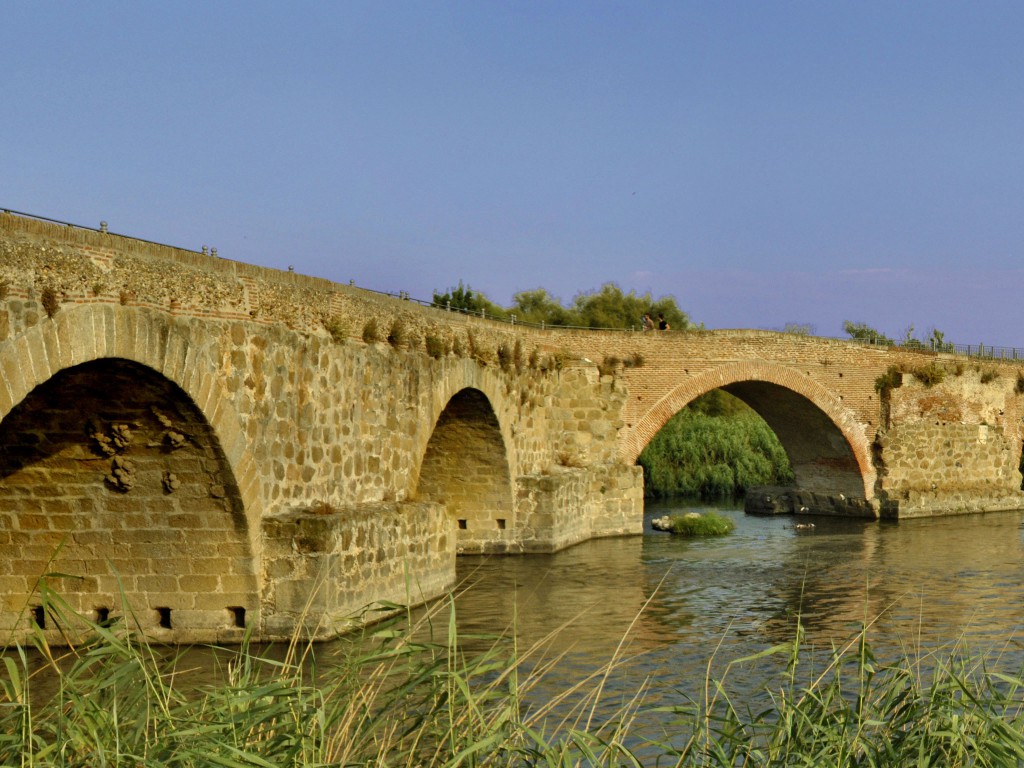
The Museo de Cerámica Ruiz de Luna, in the former convent of San Agustín at Calle San Agustín el Viejo, 13, shows how the craft developed. Most of its pieces date from the 16th to the 20th century. Tiles also cover the Basilica of the Virgen del Prado, built between the 16th and 17th centuries, and the nearby Prado Gardens. Other monuments are the bridge of Santa Catalina, the collegiate church of Santa María la Mayor, from the late 12th century, and the Mudejar church of Santiago. Workshops where ceramics are made can be seen at the Patio de los Artesanos in the old centre.
Illescas
Illescas is the main town of the La Sagra district, between Toledo and Madrid. Today it is an industrial town, but its historic centre keeps several monuments. The hospital-sanctuary of La Caridad, from the 16th and 17th centuries, has a church with five paintings by El Greco. The parish church of La Asunción combines several styles and periods, and the Ugena gate is a Mudejar structure of masonry and brick.
Tembleque and Consuegra
Tembleque is about 60 kilometres from the city of Toledo. This La Mancha village is a listed Property of Cultural Interest because of its Plaza Mayor, a square with granite columns on three sides and two upper floors of wooden galleries. It was built as a setting for bullfights and festivities. A passage links it to the smaller Plaza del Orden. Bars and restaurants occupy the arcades.
Consuegra, a town of Roman origin, sits at the foot of the Cerro Calderico ridge. On the ridge stand a castle with a double line of walls and twelve windmills of the kind associated with Don Quixote. Five of the windmills keep their complete mechanism. A Saffron Festival takes place in late October; in 2026 it is listed for 23 to 25 October.
Escalona
Escalona stands on a plateau on the right bank of the river Alberche, in the north of the province. Its castle was built by Álvaro de Luna in the 15th century and has a perimeter of 420 metres. Part of one tower collapsed in March 2026 and, according to the town council, consolidation work is being prepared, so check whether visits have resumed. The arcaded main square, the 16th-century convent of La Encarnación and the bridge over the Alberche can be seen in any case.
Planning a day trip
These towns lie in different directions from Toledo, so one or two per day is realistic. Oropesa and Lagartera combine easily, as do Tembleque and Consuegra. Bus timetables change, so confirm them with the operator or at a tourist office before travelling; a car gives more freedom in the smaller villages. Opening hours of small museums and churches vary by season.
For students based in Toledo or Madrid, these trips show sides of Castilla-La Mancha that the capital does not: craft traditions that are still alive in Talavera and Lagartera, and the landscape of La Mancha in Tembleque and Consuegra.
More about: Toledo · All blog posts