Valle de Cuelgamuros (formerly Valle de los Caídos), Madrid, Spain
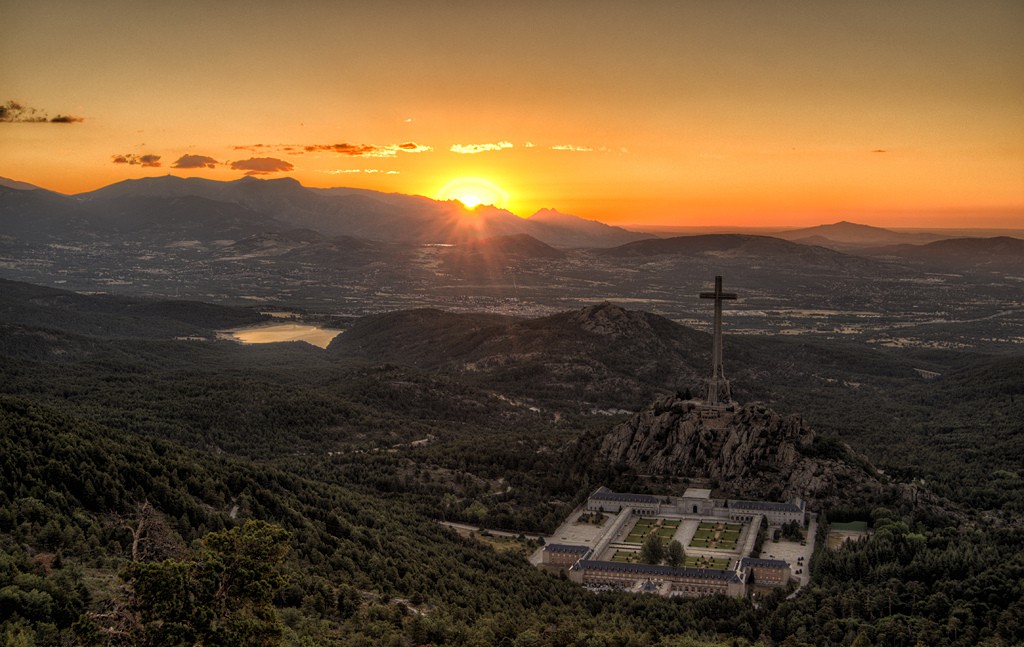
The Valle de Cuelgamuros is the monumental complex in the Sierra de Guadarrama that was known until 2022 as the Valle de los Caídos (Valley of the Fallen). It lies in the municipality of San Lorenzo de El Escorial, in the Madrid region, and is managed by Patrimonio Nacional. This post covers its history, what has changed in recent years, and the practical details of a visit in 2026.
What the site is
The complex consists of a basilica cut into the rock, an abbey and a very large stone cross. The dictator Francisco Franco ordered its construction at the end of the Spanish Civil War, and it was built between 1940 and 1958. The architects were Pedro Muguruza and Diego Méndez, and the sculptures are by Juan de Ávalos, among others.
The cross stands on the summit of the Risco de la Nava. According to the tourist office of San Lorenzo de El Escorial, it is 150 metres high and each arm measures 24 metres. The site is 9.5 km north of the monastery of El Escorial.
The same source states that 33,833 combatants from both sides of the war were buried here, together with José Antonio Primo de Rivera, founder of the Falange, and that the site has been called the largest mass grave in Spain.
What has changed
A visitor who read about the site some years ago will find several differences.
- Franco is no longer buried here. He was buried at the foot of the high altar after his death on 20 November 1975. His remains were exhumed on 24 October 2019 and moved to the cemetery of Mingorrubio.
- The name has changed. The Democratic Memory Law (Ley 20/2022) renamed the Valle de los Caídos as the Valle de Cuelgamuros and defines it as a place of democratic memory. Its purpose is to explain how the complex was built and the period it belongs to.
- New rules apply. Under the law, no political acts or acts that glorify the war, its protagonists or the dictatorship may be held anywhere on the site. The crypts next to the basilica and the burials in it have the status of a civil cemetery. Only people who died as a result of the war may lie there, and any remains in a pre-eminent place are to be moved.
- Families can recover remains. The law recognises requests from relatives for the exhumation and return of the victims buried in the valley.
- The funicular is closed. Patrimonio Nacional states that the funicular to the cross is closed indefinitely.
Opening times and prices in 2026
The site is closed on Mondays. Patrimonio Nacional sells tickets by time slot, and the ticket office closes one hour before the site. It gives the following visiting times:
- Winter (October to March): Tuesday, Thursday, Friday and Saturday at 10:00, 10:30 and from 12:00 to 4:30 pm; Wednesday and Sunday at 10:00, 10:30 and from 12:00 to 2:30 pm
- Summer (April to September): Tuesday, Thursday, Friday and Saturday at 10:00, 10:15 and from 12:00 to 5:30 pm; Wednesday and Sunday at 10:00, 10:15 and from 12:00 to 2:30 pm
In 2026 the site is closed all day on 1 and 6 January, 1 May, 13 September and 24, 25 and 31 December, and it may close on other days for official events. Patrimonio Nacional gives the length of the visit as about 30 minutes.
Basic admission costs €9. The reduced ticket costs €4 and applies to visitors aged 5 to 16, people over 65 and students up to 25 years of age with a valid national or international student card. Children under 5 enter free, and admission is free for everyone on 18 May and 12 October.
On Wednesday and Sunday afternoons, from 3 pm, admission is free for citizens and residents of the European Union and for Latin American citizens who show proof of nationality or residence. These free tickets are issued only at the ticket office.
Photographs without flash are allowed for personal use, except where signs say otherwise. Tripods and selfie sticks are not permitted. Patrimonio Nacional also states that there is currently no access for people with disabilities.
How to get there
The entrance is on the M-600 road between Guadarrama and El Escorial.
- By bus: line 660 leaves from Plaza de la Virgen de Gracia in San Lorenzo de El Escorial. From Madrid, take a bus or train to San Lorenzo de El Escorial first; the post on San Lorenzo de El Escorial explains how.
- By car: from Madrid, take the A-6 motorway and turn onto the M-600. From San Lorenzo de El Escorial, follow the M-600.
For students
The valley is a hard place to treat as ordinary sightseeing, and it helps to read about the Civil War and the dictatorship before going. It can be combined with the monastery of El Escorial on the same day, or with a walk in the Sierra de Guadarrama. Bring a student card for the reduced ticket. Courses and schools in the capital are listed on the Madrid city page.
More about: Madrid · All blog posts