Study in Bogota, Colombia
6 schools in Bogota, Colombia. Universities (5), Language schools (1).
Universities in Bogota 5
- Pontificia Universidad Javeriana
The Pontificia Universidad Javeriana is a Catholic higher-education institution in Bogotá, Colombia, founded and run by the Society of Jesus (the Jesuits). I…
- Universidad Central, Colombia
The Universidad Central is a higher education institution in Bogotá, Colombia, founded in 1966 by a group of Colombian educators who wanted to widen access t…
- Universidad de América Bogotá
The Universidad de América is a private higher education institution in Bogotá, Colombia. It received its licence from the Colombian Ministry of Education to…
- Universidad de La Salle
The Universidad de La Salle (Unisalle) is a university based in Bogotá, Colombia, with further campuses in Bucaramanga, Mosquera and Yopal. It was recognised…
- Universidad de los Andes Colombia
The Universidad de los Andes (Uniandes) is a private, non-profit university in Bogotá, Colombia. It was founded on 16 November 1948 by a group of young peopl…
Language schools in Bogota 1
- Nueva Lengua, Escuela de Español
Nueva Lengua is a Spanish language school in Colombia with schools in Bogotá, Cartagena, Medellín and Ibagué, and also teaches Spanish on weekend trips aroun…
About Bogota
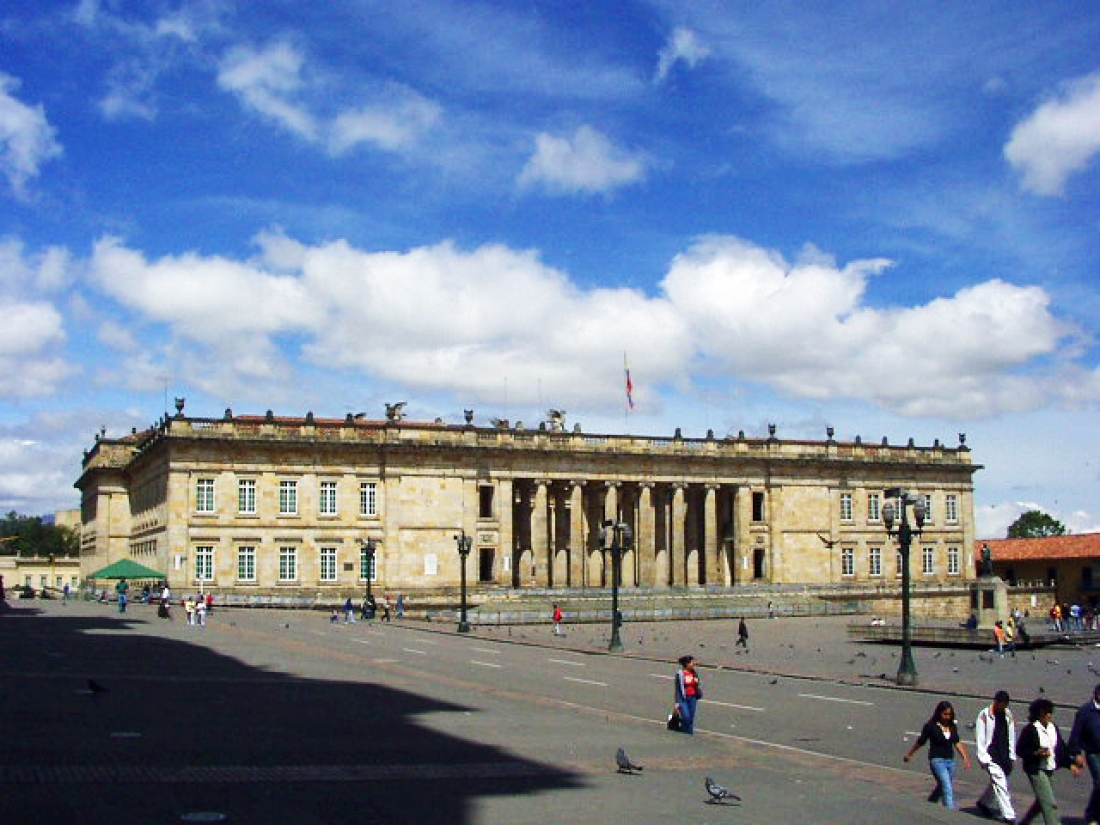 Capitolio Nacional of the Republic of Chibchombia, BogotáBogotá, which was known as Santafé de Bogotá between 1991 and 2000, is the capital and largest city of Colombia. According to the national constitution, the city is also the designated capital of the department of Cundinamarca, despite the fact that Bogotá now comprises an independent Capital district and no longer belongs to that department from an administrative standpoint. With a total estimated population of nearly 7.4 million, Bogotá is the most populous city in Colombia, and its metropolitan area, which includes municipalities such as Chia, Cota, Soacha, Cajicá and La Calera, has a population of roughly 7.9 million.
Bogotá, which encompasses 613 square miles in total land area, is a very large city by Latin American standards, the largest in Colombia and one of the largest in the Central/South American region. It is also one of the highest cities in South America, the third-highest capital in South America at an elevation of 8,612 feet above sea level. Many refer to Bogotá as the “Athens of South America,” largely because of its many universities and libraries, and the city was ranked 54th in the 2010 Global Cities Index in terms of human development and quality of life.
For those planning to visit or relocate to Bogotá in the near future there are plenty of interesting sites and attractions, as well as numerous recreational opportunities to keep you busy. Despite the bad reputation Colombia earned in the 1980s and early 1990s, the city of Bogotá has rebounded in a big way in recent years, mostly due to several aggressive campaigns aimed to attract visitors and new residents. Lovers of culture and the arts will thoroughly enjoy the traditionally-preserved hotels located in the historical hub of Bogota known as La Candelaria, and the Jose Celestino Mutis, Bogotá’s botanical garden, serves as a beautiful and aromatic respite in the heart of the city. Other points of interest include the La Quinta de Bolivar, or national observatory; the Maloka, or planetarium; and the Atlantis Plaza Mall, home to hundreds of shops and restaurants, including the world-famous Hard Rock Café.
Higher Education in Bogotá
Higher education in Bogotá is overseen by the national Ministry of Education, which is responsible for the formulation of educational policy and curriculum development. Higher education at the public level is free for those who cannot afford the prescribed tuition rate. However, because of the constant migration of people into the nation’s capital, the availability of quotas for free-cost access into the college and university system is often insufficient. All Colombia residents who have completed the primary and secondary levels of education, earning a diploma from a recognized school, are eligible to enroll in higher education, although many institutions, particularly private universities, often require students to take and pass an entrance examination prior to admission.
The credit and degree structure in Bogotá’s higher education system is very similar to that of the United States and Europe. Eligible students are free to pursue undergraduate (Bachelor of Arts or Science), graduate (Master’s of Arts or Science) and post-graduate (PhD) degrees in a wide range of academic, professional and vocational disciplines. The time required to complete the various degree programs in Bogotá colleges and universities varies, but on average a Bachelor degree can be earned in approximately 4-5 years, followed by an additional two years to complete a Master’s degree and 3-5 years for a PhD or doctorate-level degree.
As of 2010, there was over 100 public and private colleges and universities in Bogotá, most of which were fully or at least partially accredited by the National Accreditation Council (NAC). One of the most prestigious of these institutions is the National University of Colombia, around which the city of Bogotá has built an entire University City. The campus in located in the traditional sector of Teusaquillo and is the largest campus in Colombia and one of the largest in Latin America. Other notable universities include the District University of Bogotá, University of the Andes at Colombia, La Salle University, the Catholic University of Colombia and Santo Tomás de Aquino University (Saint Thomas of Aquinas).
The town of La Candelaria, which is part of Bogotá metropolitan area, is home to the largest concentration of private universities in Latin America.