Medicine Schools and Programs in Germany
14 schools in Germany teach Medicine.
Albert-Ludwigs-Universität Freiburg
University Freiburg, Germany In an official register
The Albert-Ludwigs-Universität Freiburg (Universität Freiburg) is a university in Freiburg, in south-west Germany, with its visitor address at Friedrichstraße 39. Around 24,500 students are currently enrolled. The university has eleven faculties, about 240 degree programmes…

Christian-Albrechts-Universität zu Kiel
University Kiel, Germany In an official register
The University of Kiel is an institution of higher education, operating in the city of Kiel, Germany. It was established in 1665 to currently receive about 23,000 students. The school is organized into the following faculties: Theology, Law, Business, Economics and Social…
Johann Wolfgang Goethe-Universität Frankfurt
University Frankfurt, Germany In an official register
Goethe University Frankfurt is a university in Frankfurt, Germany. The university describes itself as one of the largest universities in Germany and as the first German university rooted in a civic tradition. Teaching and research cover a wide range of disciplines, from the…
Ludwig-Maximilians-Universität Munich
University Munich, Germany In an official register
The Ludwig-Maximilians-Universität München (LMU) is a university in Munich, Germany. It describes itself as one of the largest and most research-intensive universities in Europe, with a highly differentiated range of subjects. Research and teaching are organised in faculties…
Rheinisch Westfalische Technische Hochschule Aachen (RWTH)
University Aachen, Germany In an official register
RWTH Aachen University (Rheinisch-Westfälische Technische Hochschule Aachen) is a technical university in the city of Aachen. It teaches students at bachelor's and master's level, and new students are welcomed with a first-semester orientation week of events and activities…

Rheinische Friedrich-Wilhelms-Universität Bonn
University Bonn, Germany In an official register
The Universität Bonn is a German university of excellence (Exzellenzuniversität) in Bonn, with about 31,500 students. According to the university, it has eight clusters of excellence in different research fields, more than any other university in Germany; one example is…

Technische Universität München (TUM)
University Munich, Germany In an official register
The Technische Universität München (TUM) was founded in 1868 is listed among the first in the world.
Universität Regensburg
University Regensburg, Germany In an official register
The Universität Regensburg (UR) is a university in Regensburg, Germany. It is organised into faculties, and its own institutions include the university library (UBR), a language centre (Sprachenzentrum, ZSK), central IT services (Campus IT) and a hospital (Klinikum, UKR). Its…
Universität Ulm
University Ulm, Germany In an official register
Universität Ulm (Ulm University) is a young research university in Ulm, Germany, which describes itself as the highest-situated university in the country. It focuses on medicine and STEM subjects (mathematics, computer science, natural sciences and engineering) and has about…
Universität zu Köln
University Cologne, Germany In an official register
The Universität zu Köln is a university in Cologne, Germany. In October 2026 it obtained the status of Exzellenzuniversität in a competitive national selection; according to the university, the excellence funding will support the strategic development of all its areas of…
Universität Heidelberg
University Heidelberg, Germany
Heidelberg University (Universität Heidelberg), also known as Ruperto Carola, is a research university in Heidelberg, Germany. It was established in 1386 by Ruprecht I, Elector Palatine, and is Germany's oldest university. The university describes itself as an internationally…
University of Münster
University Münster, Germany
The Universität Münster is a university in the German city of Münster whose website lists research in mathematics, the humanities and social sciences, the natural sciences and the life sciences. It coordinates the Cluster of Excellence "Mathematics Münster: Dynamics -…

Institut für Internationale Kommunikation (IIK)
Language school Düsseldorf, Germany
The Institut für Internationale Kommunikation e.V. (IIK) is a language institute in Düsseldorf, Germany, with a further location in Berlin. The Düsseldorf institute is in the central Pempelfort district, with good connections to the old town and the Hochschule Düsseldorf. Its…
Universität Duisburg-Essen
University Duisburg, Germany
The University of Duisburg-Essen (Universität Duisburg-Essen, UDE) is a university in the Ruhr region of Germany with two campuses, in Duisburg and in Essen. Together with two other universities it forms the University Alliance Ruhr (UA Ruhr), and its research is organised…
Medicine Studies in Germany
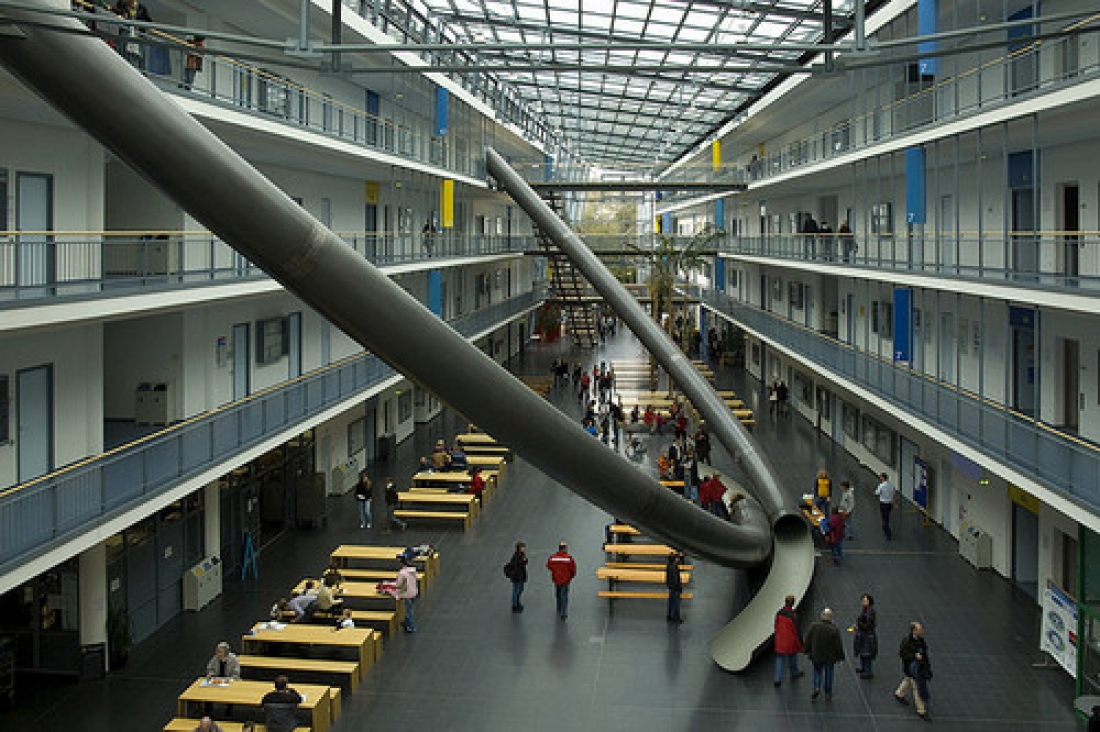 Study Medicine in Germany at Technische Universität München (Munich).
Medicine in Germany is not a bachelor's and master's degree. It is a single programme regulated by federal law, the Approbationsordnung für Ärzte, which ends with a state examination (Staatsexamen, officially the Ärztliche Prüfung) instead of a university degree. The programme is taught at universities and their teaching hospitals, almost entirely in German, and admission is restricted across the whole country.
SpainExchange lists 14 schools in Germany under Medicine: 13 universities and one language institute that teaches German for medical professionals. Munich has two of them, the Ludwig-Maximilians-Universität München (LMU) and the Technische Universität München (TUM); the others are in Aachen, Bonn, Cologne, Duisburg and Essen, Frankfurt, Freiburg, Heidelberg, Kiel, Münster, Regensburg, Ulm and Düsseldorf.
How the degree is organised
The Approbationsordnung sets the same framework for every university. Medical training consists of:
- a university programme of 5,500 hours over six years, the last year being a continuous practical year (Praktisches Jahr) of 48 weeks
- first-aid training
- a nursing placement (Krankenpflegedienst) of three months
- clinical electives (Famulatur) of four months
- the Ärztliche Prüfung, taken in three parts
The first part of the examination comes after two years of study, the second after three more years and the third after the practical year. The standard period of study, including the last examination, is six years and three months. The Universität Heidelberg, for example, lists its programme with a standard period of 12.5 semesters, a start in the winter semester only and German as the language of instruction, and describes a preclinical phase of two years followed by three clinical years and the practical year.
Universities organise the curriculum in their own way within these rules. In Munich, TUM teaches only the clinical part: the pre-clinical part is taken at LMU, and international applicants apply directly to LMU.
Admission and language
Medicine is one of four subjects with country-wide admission restrictions, together with pharmacy, veterinary medicine and dentistry. Where to apply depends on nationality:
- Applicants from EU and EEA countries apply through the Stiftung für Hochschulzulassung on its portal hochschulstart.de, on the same terms as German applicants
- Applicants from other countries apply through uni-assist or directly to the university, depending on the institution
The admission page of the Universität Ulm shows how places are allocated. Up to two tenths are reserved for priority quotas, which include foreign nationals from non-EU countries. The rest is divided into 30% for the top school-leaving grades, 10% for an additional aptitude quota and 60% for the universities' own selection procedures. The Test für medizinische Studiengänge (TMS) is one of the selection criteria in Ulm.
A school-leaving certificate from an EU or EEA country or Switzerland that gives access to university there is usually accepted in Germany. Other applicants may first have to attend a Studienkolleg, a preparatory course that ends with an assessment test. According to the German Academic Exchange Service (DAAD), most institutions require German at B2 level of the CEFR or above, proven with a test such as TestDaF, which is offered in around 100 countries, or the DSH, which is taken in Germany. Each medical faculty sets its own level, so check the faculty's requirements before applying.
Costs
DAAD states that state higher education institutions generally charge no tuition fees for undergraduate programmes. There are two exceptions for students from outside the EU: Baden-Württemberg, the state of Heidelberg, Freiburg and Ulm, charges €1,500 per semester, also for state examination programmes, and universities in Bavaria may set their own fees for non-EU students. All students pay a semester contribution of between €70 and €430; at the Universität Heidelberg, fees and contributions for Medicine are €189.80 per semester. DAAD estimates living costs at between €900 and €1,200 per month, depending on the city.
Visa
Citizens of EU member states, Iceland, Liechtenstein, Norway and Switzerland only need a valid identity card. Most other students need a national visa, applied for at the German embassy or consulate in their home country. According to DAAD, visa applicants had to prove funds of €992 per month as of 1 January 2025, and a visa can take months to be issued. Applicants who still have to pass an entrance examination or attend a Studienkolleg can apply for a prospective student visa, valid for up to nine months.
Licence to practise and careers
Passing the Ärztliche Prüfung gives the right to apply for the Approbation, the state licence to practise as a doctor, under the Bundesärzteordnung. The licence also requires the German language skills needed for the profession. Under the Approbationsordnung, the programme qualifies graduates to go on to specialist training (Weiterbildung). Medical training completed in another EU or EEA country is treated as equivalent under the same law. Doctors who trained abroad and want to work in Germany often need a medical German exam: the Institut für Internationale Kommunikation (IIK) in Düsseldorf offers German courses for doctors that prepare for the Fachsprachprüfung of the medical association (Ärztekammer).
Frequently asked questions
How long does it take to study Medicine in Germany?
The standard period of study is six years and three months. It includes a practical year of 48 weeks in hospital and a state examination in three parts.
Can I study Medicine in Germany in English?
The state examination programme is taught in German. The Universität Heidelberg lists German as its language of instruction, and TUM states that Medicine is taught completely in German.
Is Medicine free at German universities?
State universities generally charge no tuition fees, but all students pay a semester contribution of €70 to €430. Students from outside the EU pay €1,500 per semester in Baden-Württemberg and may be charged fees in Bavaria.
Where do international students apply for Medicine?
Applicants from EU and EEA countries apply through hochschulstart.de. Applicants from other countries apply through uni-assist or directly to the university they choose.